Isla Meaning in the Bible: Origins, Spiritual Significance, and True Essence
Some names feel like they were made for a quiet sunrise over the water. Isla is one of them. Short, graceful, and effortlessly elegant, it has climbed the charts in English-speaking countries worldwide, not because of passing trends, but because it carries something deeper. Parents are not just drawn to how it sounds. They are drawn to what it means. And increasingly, families of faith are asking a very specific question: what is the Isla meaning in the Bible, and does this name carry any spiritual weight?
This article answers that question honestly and thoroughly. You will find Isla’s true linguistic origins, its biblical symbolism, its Hebrew connections, cultural interpretations, and everything else that makes this name spiritually rich and meaningful for Christian families today.
What Does the Name Isla Mean? (Definition and Etymology)
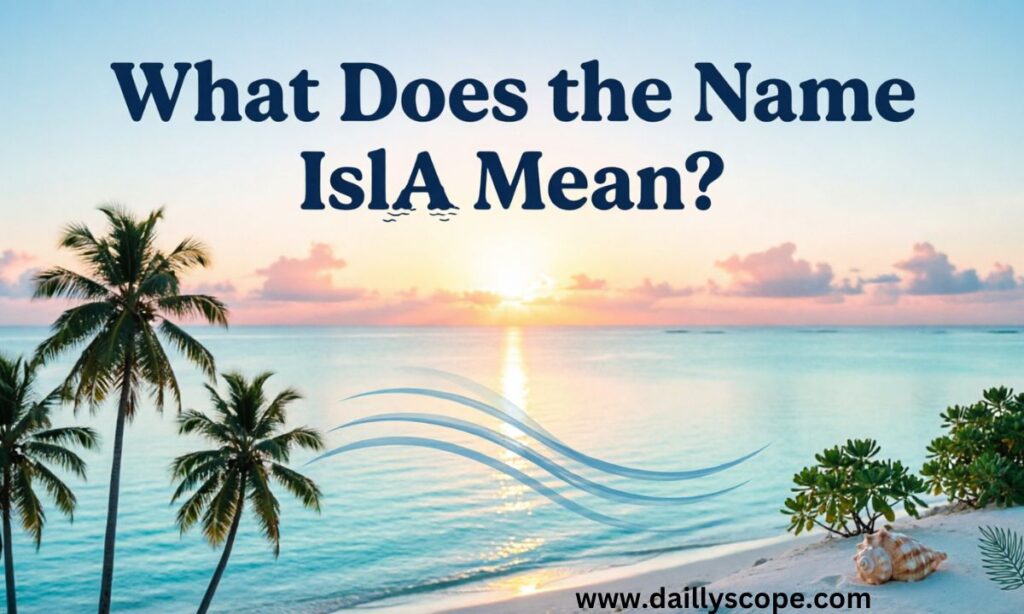
At its simplest, Isla means “island.” The name carries this meaning through two distinct linguistic pathways, which gives it a uniquely universal appeal.
The primary origin is Scottish Gaelic, where Isla derives from Islay, the southernmost island of the Inner Hebrides off the west coast of Scotland. Islay is famously known as “The Queen of the Hebrides,” a rugged, beautiful landmass associated with peaty whisky, dramatic coastlines, and centuries of Gaelic culture. Over time, Islay softened into Isla and transitioned from a masculine place name into a feminine given name.
The secondary origin is Spanish, where isla is simply the everyday word for “island.” This connection is rooted further back in Latin, where insula carried the same geographic meaning.
| Origin | Language | Literal Meaning |
| Primary | Scottish Gaelic (from Islay) | Island |
| Secondary | Spanish | Island |
| Root | Latin (insula) | Island |
What does an island represent beyond geography? It is a place set apart. Surrounded by water on all sides, it stands on its own. It offers shelter, stillness, and a sense of being distinct from the surrounding chaos. For a name, that is a remarkably powerful identity to carry through life.
Read This: Tyler Name Meaning in Bible: Origin, Faith & Symbolism
Biblical Origins and History of the Name Isla
The name Isla does not appear in the Bible as a personal name. This is worth stating plainly and honestly, because trustworthy information matters more than stretching the truth to make a name sound more religious. The Bible was written in Hebrew, Aramaic, and Greek, and Isla belongs to Scottish Gaelic and Spanish linguistic traditions, not to those ancient scriptural languages.
However, the concept that Isla embodies is deeply present throughout Scripture.
Islands in the Old Testament appear repeatedly in prophetic and poetic literature as symbols of distant, unreachable places that God nonetheless claims. In Isaiah 42:10, the coastlands and islands are called to sing a new song to the Lord. In Isaiah 49:1, the islands listen as God speaks of His servant. In Psalm 97:1, the islands rejoice at the Lord’s reign.
Islands in the New Testament also carry significance. The Apostle John received his revelation on the island of Patmos. Paul was shipwrecked on Malta. These islands became turning points in the biblical story.
So while Isla is not a biblical name in origin, its core meaning connects directly to a recurring scriptural image: the island as a place of divine encounter, separation from the world, and spiritual purpose.
Christian families throughout history have chosen names not only from Scripture but from words and concepts that reflect biblical truth. Isla fits naturally into that tradition.
Is the Name Isla Mentioned in the Bible?

No, Isla is not mentioned in the Bible. There is no biblical character, patriarch, prophet, or place that carries this specific name. Any source claiming otherwise is either mistaken or stretching symbolism beyond honest interpretation.
What the Bible does contain is powerful imagery around the concept of islands, which gives the name Isla its spiritual resonance.
Here is how biblical island imagery aligns with the spiritual qualities parents associate with Isla:
- Refuge and safety — Psalm 46:1 declares that God is “our refuge and strength, a very present help in trouble.” An island, by its nature, is a place of refuge surrounded by the waters of the world.
- Being set apart — The concept of being called out and set apart for God’s purposes is central to Scripture (1 Peter 2:9). An island is, by definition, set apart from the mainland.
- Peace and stillness — Islands evoke stillness. Psalm 23 speaks of still waters and quiet restoration, a peace that transcends circumstance.
- God’s sovereign reach — Isaiah’s repeated reference to the islands reminds believers that no place is beyond God’s love or authority.
These themes make Isla feel spiritually resonant even without a direct scriptural mention.
The Spiritual Meaning of the Name Isla
Spiritually, Isla represents a soul set apart for God’s purposes. Still, anchored, and surrounded by the waters of life, yet unshaken.
The spiritual meaning of Isla can be understood through three layers:
1. Refuge and Peace Like an island standing firm in the middle of a restless ocean, Isla symbolizes the peace that faith provides. This mirrors one of the most consistent promises in the Bible: that God is a place of shelter for those who trust in Him (Proverbs 18:10).
2. Being Called Apart An island does not blend into the sea. It holds its ground. For believers, this reflects the biblical calling to be “in the world but not of it” (John 17:16). A child named Isla carries the quiet identity of one who is distinct, grounded, and set apart by purpose.
3. Strength Through Stillness Islands do not resist the ocean with force. They simply stand. There is a profound spiritual lesson in that image: strength that does not shout, resilience that does not strain. This connects beautifully to Isaiah 30:15, “In quietness and confidence shall be your strength.”
Isla Name Meaning in Hebrew and Its Deeper Symbolism
Isla is not a Hebrew name. It does not appear in the Hebrew scriptures and has no direct Hebrew equivalent. However, there are a few fascinating phonetic and symbolic connections worth exploring.
Eilah (אֵילָה) — The Hebrew word Eilah or Elah refers to the terebinth or oak tree, a symbol of strength, longevity, and deep roots. Some name researchers note the phonetic similarity between Eilah and Isla, and the symbolic overlap: both the island and the mighty tree represent things that stand firm in the face of natural forces.
Shalom (שָׁלוֹם) — The Hebrew concept of shalom goes far beyond the simple English translation of “peace.” It encompasses wholeness, completeness, harmony, and flourishing. The spiritual essence of Isla, a place of quiet refuge and completeness, maps beautifully onto this ancient Hebrew concept.
Ilana (אִילָנָה) — A Hebrew feminine name meaning “tree,” Ilana shares sound similarities with Isla and carries the same symbolic weight of rootedness and beauty.
| Hebrew Word | Meaning | Connection to Isla |
| Eilah | Terebinth tree / Oak | Strength, deep roots, standing firm |
| Shalom | Peace, wholeness, flourishing | Core spiritual meaning of Isla |
| Ilana | Tree | Feminine, rooted, naturally beautiful |
These connections are symbolic rather than etymological, but for parents looking for a name that resonates with Hebrew scriptural wisdom, Isla carries meaningful parallels.
Cultural and Religious Interpretations of Isla
Across cultures and faith traditions, the name Isla has gathered layers of meaning that complement its spiritual core.
In Scottish Christian Culture Isla grew within a Gaelic Christian context where the natural world was deeply intertwined with faith. The Celtic Christian tradition saw mountains, rivers, and islands as sacred spaces, places where the boundary between the earthly and divine felt thin. Naming a child Isla within this tradition carried the weight of that reverence.
In Spanish-speaking Catholic Communities Because isla means island in Spanish, the name is occasionally used among Latin American Catholic families. Its simplicity and elegance make it a gentle, faith-neutral choice that crosses denominational lines.
In Modern Christian Families Today, many Christian parents choose Isla precisely because of its symbolic meaning. A name that means “island” invites reflection on God as our refuge, on the calling to be set apart, and on the peace that Scripture repeatedly promises to those who trust in God. It is a name that holds theology without wearing it on its sleeve.
In Celtic Mythology In pre-Christian Celtic culture, islands held mystical significance. The legendary Tír na nÓg, the “Land of Eternal Youth,” was believed to exist on an island beyond the western sea. While this is mythology rather than Scripture, it shows how deeply the island concept is woven into the cultural imagination from which Isla emerged.
Nicknames and Variations of the Name Isla
Because Isla is only four letters long, it is already one of the most compact elegant names in use. It rarely requires shortening, but affectionate nicknames have naturally evolved.
Popular Nicknames for Isla:
- Izzy — The most common nickname, playful and friendly
- Issy — Popular in Scotland, warm and familiar
- Isie — A sweet diminutive used in early childhood
- Isle — Poetic and geographic, stays close to the original
- Lala — Often created by younger siblings learning to say the name
- Icy — Occasionally used for winter-born babies
International Variations of Isla:
| Variation | Language/Culture | Notes |
| Islay | Scottish | Original place name, occasionally used |
| Isela | Spanish | Melodic Latin American variant |
| Isolde | Germanic/Medieval | Shares ancient roots, more elaborate |
| Ilana | Hebrew | Meaning “tree,” similar sound |
| Eila | Finnish | Phonetically close, Nordic feel |
| Aisla | Scottish | Alternate spelling in Scottish communities |
| Ila | Various | Simplified short form |
Isla Name Popularity and Global Usage Trends
The name Isla has experienced a remarkable rise over the past two decades, transforming from a quietly regional Scottish name into a globally recognized favorite.
United States: Isla currently ranks at #28 in the U.S. baby name charts, placing it firmly among the most popular girl names in the country.
United Kingdom and Scotland: In its homeland, Isla ranks #2 in Scotland and #4 in England and Wales, reflecting its enduring connection to its Celtic roots.
Australia and New Zealand: Isla holds #3 in Australia and an extraordinary #1 position in New Zealand, making it the most popular girl name in the country.
Other English-speaking regions: Ireland ranks it at #13, and Canada at #13 as well.
What drove this surge in popularity?
Several factors converged to push Isla into the mainstream:
- The rise of Isla Fisher, the Australian actress known for Wedding Crashers and Confessions of a Shopaholic, introduced the name and its correct pronunciation (Eye-la) to global audiences.
- In 2012, Isla Phillips, great-granddaughter of Queen Elizabeth II, was born, adding royal elegance to the name.
- The broader trend toward short, nature-connected names (Ivy, Willow, River) made Isla feel perfectly timed.
- Its phonetic simplicity — two syllables, four letters, consistent spelling — made it practical for parents worldwide.
Famous People Named Isla and Their Influence
Real-world bearers of the name have helped shape its cultural identity and global reach.
Isla Fisher — Born in Oman and raised in Australia, Isla Fisher is one of the most recognized actresses of her generation. Her roles in Wedding Crashers (2005), Confessions of a Shopaholic (2009), and Now You See Me (2013) brought the name into living rooms worldwide and made it feel both sophisticated and approachable.
Isla Blair — A respected British actress of Scottish descent with a long career in British film and television, Blair represents the name’s grounded, classical heritage.
Isla Cameron — A Scottish actress and folk singer who performed during the mid-twentieth century, Cameron kept the name alive in artistic circles long before its modern revival.
Isla St. Clair — A Scottish television presenter and singer, born Isabella Margaret Dyce, who adopted Isla as her stage name, drawn by its musical Gaelic charm.
Isla Phillips — Born in 2012 as the granddaughter of Princess Anne and great-granddaughter of Queen Elizabeth II, she added a layer of royal prestige that resonates with families who love the name’s dignified simplicity.
What Does Isla Represent in Christian Faith?
In Christian faith, Isla represents several qualities that resonate deeply with biblical teaching.
A Soul Set Apart The Bible repeatedly speaks of believers as a people called out of the world, distinct in their identity and purpose. An island, by its very nature, is set apart from the mainland. A child named Isla carries this quiet theological statement: she is known, she is chosen, and she stands apart with purpose.
God as Our Refuge Psalm 46:1 is perhaps the most powerful verse that echoes Isla’s meaning. When the seas roar and the mountains shake, God remains the steady ground. An island standing in the ocean is a perfect image of that promise. A soul anchored in God can weather every storm.
Peace That Passes Understanding Philippians 4:7 promises “the peace of God, which surpasses all understanding.” Isla, as a name meaning island, evokes that kind of peace. Not the absence of trouble, but steadiness in the middle of it.
Strength Through Gentleness Islands do not resist the sea. They simply hold their ground. This is the picture of Christlike strength: gentle, unforced, deeply rooted. For a little girl growing up in faith, Isla is a name that points toward that kind of character.
Beautiful Middle Names That Pair Well with Isla
Because Isla is short and ends in a vowel sound, it pairs best with middle names that offer contrast through consonants or additional syllables.
Classic Middle Names for Isla:
- Isla Grace — Simple, timeless, and spiritually meaningful
- Isla Rose — Soft and natural, evokes beauty
- Isla Faith — A powerful spiritual declaration
- Isla Joy — Uplifting, bright, and joyful
- Isla Mae — Sweet, vintage, and effortlessly charming
- Isla Claire — Clean and elegant
- Isla Jane — Classic British simplicity
Longer Middle Names for Isla:
- Isla Elizabeth — Regal and grounding
- Isla Josephine — Vintage and distinguished
- Isla Genevieve — Dramatic and beautiful
- Isla Catherine — Timeless and refined
- Isla Penelope — Lyrical and elaborate
- Isla Victoria — Strong and classic
Nature-Inspired Middle Names:
- Isla Violet — Floral and feminine
- Isla Wren — Short, nature-connected, modern
- Isla Fern — Earthy and gentle
- Isla Aurora — Luminous and evocative
The name Isla Faith deserves special mention for faith-based families. Simple and powerful, it carries both beauty and theological meaning in just four words.
Conclusion
The name Isla may not appear on any page of Scripture, but it is thoroughly biblical in spirit. Its meaning, “island,” connects to some of the most powerful images and promises in the Bible: refuge in the storm, peace beyond understanding, being set apart for a divine purpose, and the quiet strength of a soul anchored in God.
Its roots are Celtic, its sound is universal, and its spiritual resonance is genuine. From the coastlines of Scotland to the prophecies of Isaiah, the image of the island as a sacred, set-apart place has always carried theological weight. A child named Isla carries that weight gracefully, without even having to say a word.
For Christian families seeking a name that is both beautifully simple and quietly profound, Isla delivers on every level.

Welcome to daillyscope.com! James Carter is a passionate writer and digital content creator dedicated to sharing meaningful Bible verses, spiritual insights, and SEO-friendly content. His goal is to deliver simple, engaging, and reader-friendly articles that inspire and guide online readers every day.